
Sustainable management in the European extractive sector
In Europe’s extractive sector, both policy and industry efforts have gone a long way to improve environmental performance, increase trust towards local community and society overall, and satisfy needs for minerals needed in the twin digital and green transition. Still, challenges remain on various fronts.
Environmental Challenge
Mineral extraction is still a very land, energy and waste intensive activity, with a plethora of potential negative consequences for the environment if not adequately managed. For example, new extractive projects and the sector as a whole need to increase efforts along several lines:
- To counteract the destruction of biodiversity and ecosystems, accountable land management and rehabilitation plans need to be implemented.
- To avoid pollution of the local environment and water bodies, all waste streams, including tailings need to be properly managed.
- To further reduce related GHG emissions, energy efficiency and the electrification of extractive activities with renewable energies need to be pursued further.
Local Benefit & Societal Contract Challenge
The extractive sector in Europe enjoys a greater degree of acceptance compared to other world regions, due to the levels of trust in public administration and their role in balancing different citizens interests. However, while the extension of extractive operations or increased competition with other land uses compromise acceptance of operations on the local level, priorities to secure supply remain on the national level. To meet these challenges, new extractive projects and the sector as a whole need to increase efforts along several lines:
- communities expect companies to engage with them beyond the legislative requirements;
- as priorities shift within society, companies must develop strong lines of continuous consultation to address these expectations; and
- in many cases, this requires new ways of collaboration on sharing benefits and mitigating costs.
Demand Challenge
The EU’s ambitious transition towards an inclusive, greener and more digital economy, aiming at achieving carbon neutrality and a global digital leadership role by 2050, will drastically increase the demand for minerals. The technologies needed for these efforts range from wind turbines and PV panels to electric vehicle batteries and motors, as well as ICT semiconductors. All these rely on a secure supply of minerals and increase pressure on primary extraction in Europe and elsewhere.
- Supply chain resilience for EU industry: One strategy to increase the security of these supply chains, and adequately manage supply risks, especially for Critical Raw Materials, is the ambition to source (where possible) increasing amounts of these materials inside Europe. The EU’s Critical Raw Materials Act (CRM Act) strengthens sourcing within Europe in different stages of raw materials value chain. This fundamental policy shift calls for the need of a stronger European sustainability framework.
- Sustainability Principles permeating EU policy: The EU Principles for Sustainable Raw Materials ensure that sustainable management and secure supply are an overarching goal in EU policy. This increased focus on mined materials and sustainability along their value chains is a milestone for steering the European extractive industry towards sustainable management.
- Site-specificity: Mineral extraction faces challenges that are very specific to its location – European-centric and site-specific: The challenges related to extractive activities in Europe are dependent on the geographic location of the mine site. On average, EU regulation has higher standards compared to other world regions, largely mitigating structural issues (e.g. child labour, illegal disposal of waste streams). Issues, such as water scarcity will be more prevalent in arid regions, whereas potential land disputes with indigenous populations might only occur in a few select places.
Challenges in achieving a level playing field for the extractive sector within Europe
There are many instances where national or regional policies affecting extractive activities is incoherent with the intent or goals of relevant EU policy. This leads to additional barriers to entry for actors and further renders some regions less attractive for prospective extractive projects. From an EU perspective, these local policies hinder the creation of a level playing field for the extractive sector within Europe. An example of such a divergence is the criteria catalogue, which devises which projects need to carry out an Environmental Impact Assessment, where many Member States have criteria that are not aligned with the EU directive or other Member States.
An EU policy landscape
Both the European Union and its Member States affect practices in the extractives sector via different means of mandatory or incentivising approaches. The European Union, for example, influences the extractive industry either by:
- guiding and voluntary frameworks (e.g. Critical Raw Materials Action Plan); or by
- mandatory regulatory requirements for environmental and social standards in the form of directives and regulations which are not specific to the extractive sector (e.g. Environmental Impact Assessment Directive). With some exceptions, such as the Extractive Waste Directive and the CRM Act.
While the EU’s regulatory capacity (via the upcoming CRM Act) will more directly influence primary sourcing along raw material value chains in the EU, most influence remains with individual Member States. It has to be clear from the beginning that both the European Union and individual national governments in Europe heavily influence extractive industry practices.
A New policy drive for EU extractive operations
The upcoming CRM Act sets clear benchmarks for domestic extraction along strategic raw material supply chains: Next to processing and recycling targets, at least 10% of the EU's annual consumption of strategic raw materials shall be sourced from primary extraction. Skills development and innovation, identifying and support for strategic projects, as well as sustainable management of operations are important accompanying measures to meet these benchmarks.
The way forward to a European extractive sector based on sustainable management
Handling the EU policy landscape and the various challenges ahead, the management and exchange of knowledge are a key driver for this sustainability transition. The SUMEX Toolkit provides decision-makers in the extractive sector with a future-oriented sustainability framework for key action areas, discover best practice approaches, as well as easy to understand and actionable learning materials.
A future-oriented sustainability framework - Preventing negative impacts and enabling a positive legacy
Improving the security and affordability of CRM supply needs to be accompanied by increased efforts to mitigate the negative impacts of mineral extraction, i.e. labour rights, human rights and environmental protection.
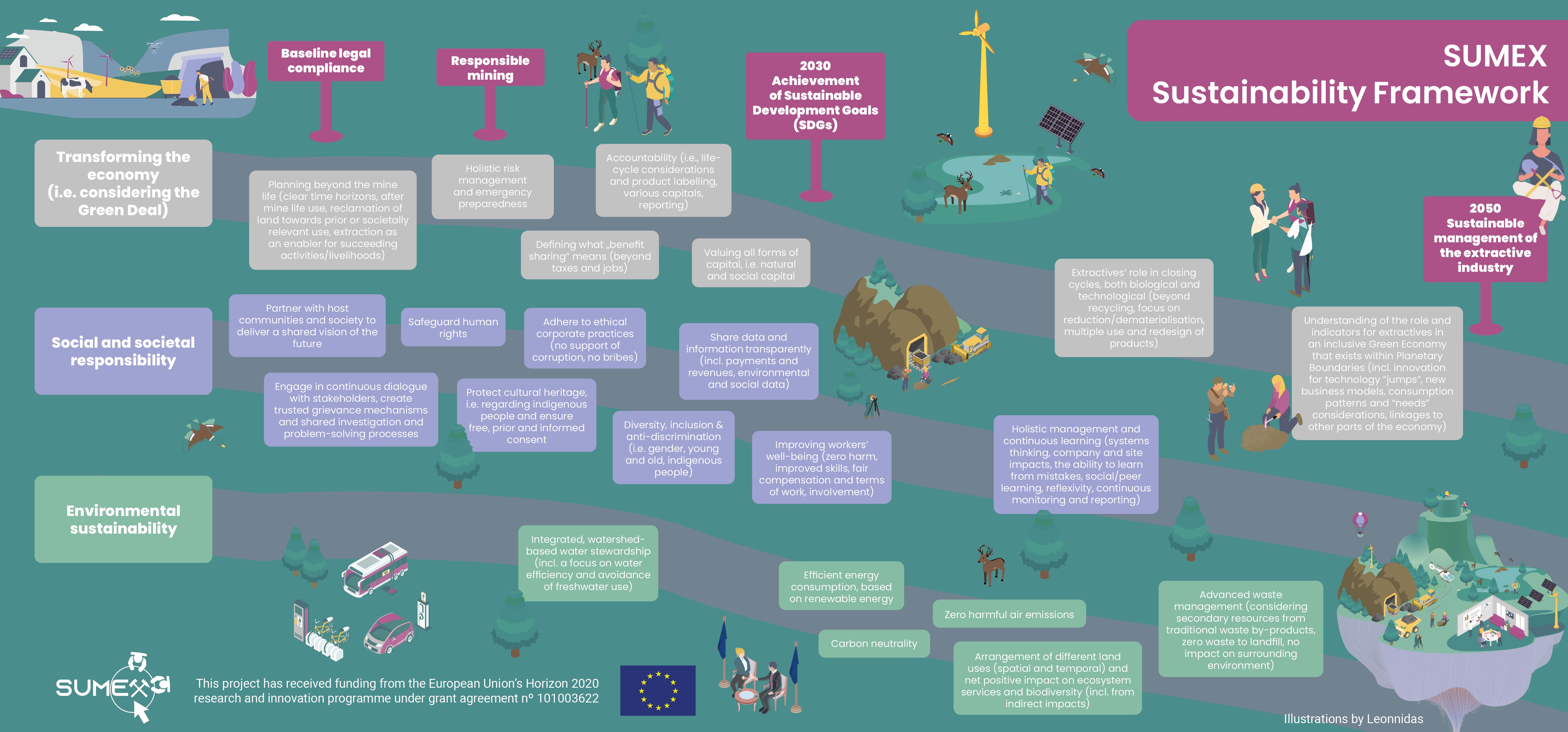
The SUMEX Sustainability Framework can be used by decision-makers to get a holistic and future-oriented understanding of sustainable management in the extractives. It offers a multi-actor based view (validated with decision-makers from industry policy and civil society), translates major societal challenges for the extractive sector (e.g. water, planetary boundaries, fundamental rights of vulnerable groups etc), and is tied to actionable and practice-oriented solutions
Sustainability framework:
Your Portal for actionable good practice - Sustainable management practices across the entire extractive value chain
Your One-Stop-Shop for open access to knowledge on how to change the extractive sector towards sustainability. Navigate through the industry- and policy practices, training materials, reports, and much more.
The SUMEX Knowledge Repository combines over 370 practices for open access knowledge on how to change the extractive sector towards sustainability. It enables the navigation through the industry- and policy practices, training materials, reports, and much more. With the possibility to submit practices, the repository will keep growing with new initiatives being added.
Preparing future decision-makers for sustainability challenges
To best prepare industry and policy decision-makers, more awareness must be raised for the importance of sustainable management. Learning materials with practical solutions tied to scientifically based approaches with societal relevance: The SUMEX Massive Open Online Course (MOOC) is here to orientate decision-makers on the most pressing issues and practical challenges faced by decision-makers, based on scientific materials and cutting-edge insights curated by renowned experts, and combines state of the art sustainability concepts with established and disruptive practices on the operational level.
Online Course: Sustainable Management in the Extractive Industry
The SUMEX Project
SUMEX is a 36-month project funded by the European Commission that started on 1 November 2020. The project aims to establish a sustainability framework for the extractive industry in Europe, with the involvement of stakeholders from civil society, academia, industry and government backgrounds from all across the EU.
Check the project introduction here.